
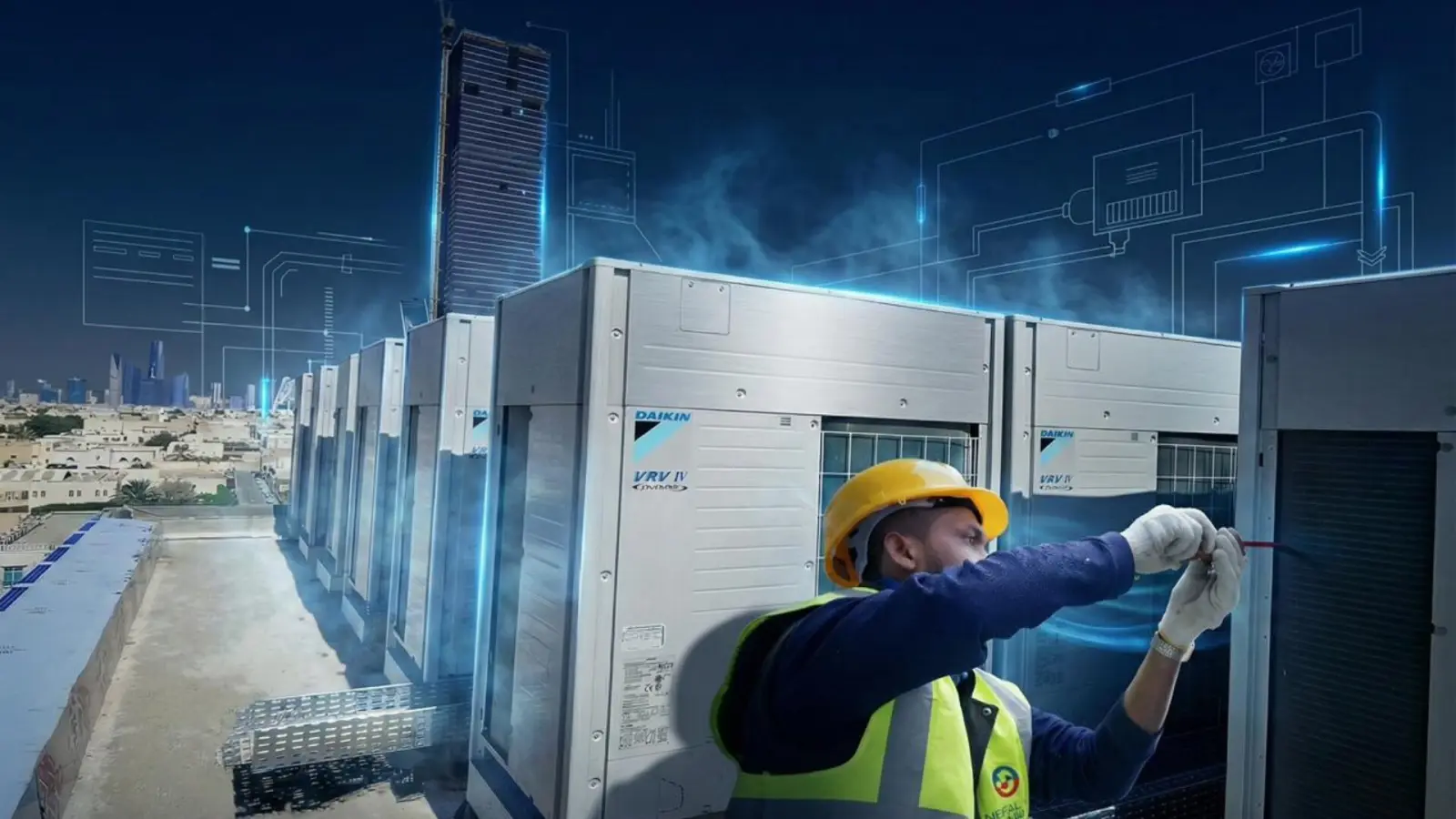
When you see air ducts in a building, you may expect the air conditioning system to be central. However, the duct alone does not determine the type of system. It is a means of carrying and distributing air through the spaces, and it can be used with different AC systems.
To understand the difference, this article outlines the main differences between the central packaged AC system (the “package”) and the separate concealed AC system, and what to consider when choosing one of them for your project.
Why are central and concealed systems often confused?
The two systems look alike in their final form inside the space: air arrives through distribution outlets connected to the ducts, while most of the equipment remains out of sight.
However, the main difference lies in the equipment configuration, its locations and how it is connected, not in the shape of the air outlets. Also, the term “central AC” covers several types of systems, not only package units.
What is a central packaged AC system (package)?
A package system combines the main cooling components in a single unit placed outside the building, usually on the roof, and connects to the interior spaces through air ducts.
In a separate system, by contrast, the components are split between an indoor unit and an outdoor unit, connected by refrigerant piping. This is one of the main differences between the two configurations.
Choosing the location of a package unit requires early coordination that takes into account duct routes, the available space, and access to the unit for maintenance.
What is a separate concealed AC system?
A separate concealed AC system consists of an indoor unit, usually installed above the false ceiling, and an outdoor unit connected to it by refrigerant piping. The indoor unit distributes air to the served space through ducts and air outlets.
Therefore, the presence of a duct inside the room is not enough to conclude that the system is a package system. It may be connected to a concealed AC unit inside the building.
Key points in this system include providing enough space for the indoor unit, suitable access openings for maintenance, and coordination with other services above the ceiling.
Does the presence of ducts mean fresh air is provided?
The presence of a duct alone does not prove that the system supplies the space with fresh air from outside. Distributing conditioned air and renewing air are two different functions, and it must be verified how ventilation is provided within the project design.
Also, some concealed units can deliver fresh air according to their equipment and installation requirements. Therefore, it is not accurate to generalize that all concealed systems either provide it or prevent it.
Which is more suitable for your project?
The choice depends on the building’s needs and how it is used. Before deciding, the following should be studied:
- The thermal loads required for each space.
- The layout of the rooms and their usage schedules.
- The level of control required for each zone.
- The available areas on the roof and above the ceilings.
- Ventilation and fresh air requirements.
- Ease of maintenance and operating costs.
For example, the requirements of a large hall operating at specific times differ from those of multiple rooms whose users want to run each one independently. Therefore, a proper comparison begins with understanding the project, then selecting the system and its suitable equipment.
Frequently asked questions
Do air outlets reveal the type of AC system?
Not on their own. The connected equipment and how the system is configured must be known.
Does central AC mean one unit for the entire building?
Not necessarily. The building may be divided into zones served by multiple units, according to the design and operating requirements.
Can the right system be determined from the area alone?
Area is one factor, but it is not sufficient on its own. Usage, insulation, glazing, occupancy and other factors affecting the thermal load must also be taken into account.