
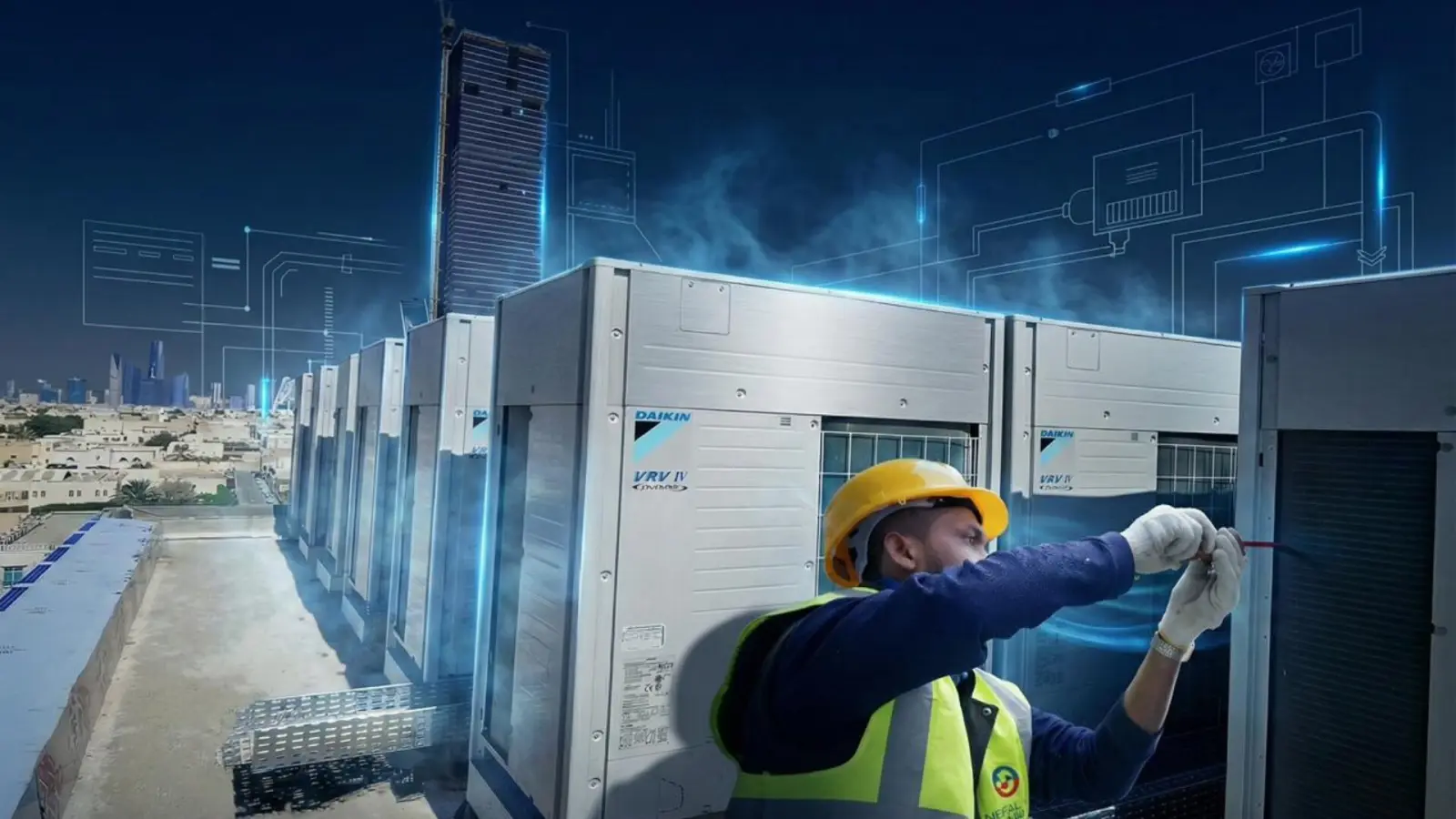
How can a multi-storey building be air conditioned when the outdoor units are on the roof and the rooms are spread across distant floors? And can AC piping cover these distances?
Here, one of the advantages of VRV and VRF systems appears: flexibility in distributing indoor units and connecting them to a refrigerant piping network. However, understanding the limits of this network is important before selecting the system or adopting the installation routes.
What are VRV and VRF systems?
These systems rely on controlling the refrigerant flow to meet the needs of different zones within the building, with the ability to connect several indoor units to an outdoor unit system.
The term VRF refers to variable refrigerant flow technology, while VRV is a registered trademark of Daikin for its technology within this category. These systems allow the different zones to be controlled according to the system design.
Can the copper piping network really reach 1,000 meters?
Yes, some models allow total pipe lengths of up to 1,000 meters, in accordance with the manufacturer’s requirements.
However, this figure represents the sum of the lengths of the piping network sections and branches, not the route length from the outdoor unit to a single indoor unit.
For example, Daikin states that some of its models allow a pipe length of up to 165 meters for the specified route, and a total network length of up to 1,000 meters. Therefore, the two figures must be distinguished when reading specifications.
What is the difference between network length, distance and height difference?
When designing the system, there are different limits that must be reviewed separately:
- Total network length: the sum of pipe lengths according to the calculation method specified by the manufacturer.
- Route length to the indoor unit: the actual pipe route length, including vertical and horizontal runs.
- Equivalent length: a calculated length that takes into account the effect of some joints and elbows.
- Height difference: the vertical distance between units; there are also limits between the indoor units themselves.
- Distance after the first branch: has specific requirements that vary by system.
Manufacturer catalogues specify each of these limits separately. Therefore, allowing a long network does not mean that any unit layout can be implemented without review.
Why are these systems offered for multi-storey buildings?
They offer more flexibility in pipe routing, giving designers wider options when distributing indoor units and determining the locations of outdoor equipment, especially when the served spaces are far apart.
However, the system’s suitability for a specific project requires studying the thermal loads, pipe routes, height differences, the limits of the selected model, and operation and maintenance requirements.
Also, the pipes running between the units carry refrigerant, whereas the duct connected to the concealed indoor unit distributes air within the served space.
Are VRV and VRF suitable for all projects?
These systems can be considered for towers, administrative buildings, schools, villas and others, but the building type alone is not enough to make the decision.
In projects with large loads, alternatives should be compared, including chilled water systems (chillers), based on the project’s needs and the cost of installation, operation and maintenance.
Likewise, a fixed electricity saving percentage should not be assumed merely by choosing VRF. Assessing consumption requires comparing specific systems under similar operating conditions.
Frequently asked questions
Does every VRF system allow a network one kilometer long?
No. Limits vary depending on the manufacturer, series, model and system configuration, and the data for the selected equipment must be consulted.
Can outdoor units be installed on the roof to serve the lower floors?
Yes, this is possible within the approved limits for pipe lengths and height differences, and after reviewing the design.
Is pipe length the only factor in selection?
No. Loads, unit distribution, controls, ventilation requirements, maintenance and operating costs must also be studied.